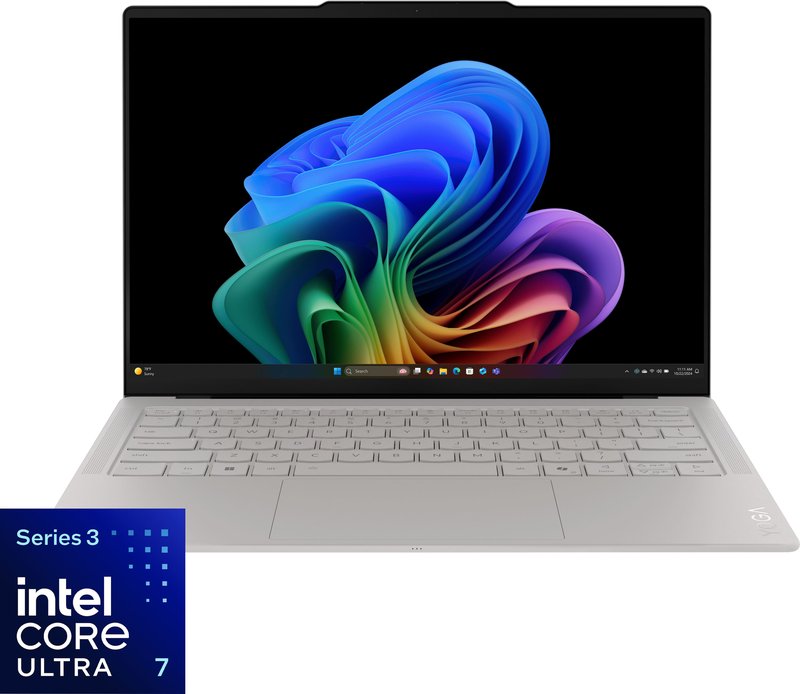
For a business traveler whose ticket gives them a strict 7 kg cabin allowance, the Lenovo Yoga Slim 7i Ultra Aura Edition is a good first look if portable Windows work is the priority. The 14-inch Gen 11 model starts at 975 g and carries a 75Wh battery, which leaves room in a small bag for the charger and the display adapter an unexpected meeting may require. The ThinkPad X1 Carbon Gen 14 is worth quoting beside it when a customer expects you to arrive with a direct HDMI connection and a USB-A clicker. Lenovo product specifications · US configuration page.
This comparison begins at the gate with a bag that already contains clothes, a water bottle and printed material. A 180 g saving only counts if the same laptop still opens the client file and drives the room display. Check the allowance on your ticket and whether the airline counts a second item together with the cabin bag. The 7 kg limit below is the allowance in the example, and each itinerary can have a different rule.
The shortlist at a glance
The first gate is the deliverable and any employer requirements. Open the client’s file format and attach the essential hardware using a checked sample. Then compare the packed dimensions and weight. Finally put the price and regional support for the exact U.S. order beside the itinerary. A model should stay on the list only when the travel work has a reliable route through each of those checks.
| US reference | Device mass | Screen | Battery | Best fit in this comparison |
|---|---|---|---|---|
| Yoga Slim 7i Ultra | 975 g starting | 14-inch 2880 × 1800 OLED touch | 75 Wh | An x86 Windows kit near 1.3 kg |
| ThinkPad X1 Carbon Gen 14 | under 1 kg at family start | 14-inch WUXGA touch on this reference | 58 Wh | Direct connections when the client supplies equipment |
| Zenbook A14 | about 980 g at family start | 14-inch 1920 × 1200 OLED on reference family | 70 Wh | A second very light option after an Arm trial |
| LG gram 14 | 2.47 lb listed, about 1.12 kg | 14-inch 1920 × 1200 IPS on the US model | 72 Wh | Several USB-A tools in a modest office workload |
| MacBook Air 13 M5 | 1.23 kg listed | 13.6-inch 2560 × 1664 Liquid Retina | 53.8 Wh | A Mac-based itinerary with one familiar video cable |
| Zenbook S 14 | about 1.2 kg listed for UX5406SA | 14-inch 2880 × 1800 OLED touch on the reference | 72 Wh | Room-ready ports with the higher-resolution 14-inch panel |
Consider US laptop bodies with a reference or starting mass around 1.50 kg or below, then weigh the complete travel or teaching kit separately. For detachable models, measure the tablet alone and again with every accessory needed for the day. This comparison uses the manufacturer’s stated figures where available. Panel, finish and component changes can move the weight. Battery capacity in watt-hours describes stored energy, and runtime depends on the workload and the configuration tested.
For the broader shortlist, compare the same order with the business-travel size and weight comparison. Keep the preferred candidate’s order code beside the review so any difference in screen or connectors is easy to recognise.
Weigh the electronics after the rest of the bag is packed
Suppose a 7,000 g allowance includes a 780 g bag and 4,860 g of personal and work supplies. The electronics envelope is 1,360 g. An illustrative 975 g Yoga body, a 190 g charger and cord, a 45 g display adapter and a 75 g sleeve sum to 1,285 g. That leaves 75 g of cushion. Take those accessory masses from a scale for your own kit. A premium sleeve, a second plug head or one extra cable can eat the margin without changing anything about the laptop.
Now build the same packing list for the machine with native HDMI. If the supplied power adapter happens to weigh 245 g, the travel kit may end up heavier than the unit that needs a lightweight converter. Conversely, one well-chosen direct connector may let you remove a large hub. Weigh bag and kit together, then walk a few minutes with the load to check whether the weight sits comfortably against your back. A nominal difference below your scale’s consistency is a poor basis for a purchase.
Keep a client file independent of the connection
Choose the item you are traveling to deliver before choosing a screen upgrade. A real test for this itinerary is a versioned PowerPoint deck with embedded media, a local PDF copy and the spreadsheet that feeds one chart. Open the approved copies once while disconnected from the internet. Open the spreadsheet again through the employer’s normal sign-in path after reconnecting. Credentials, cloud placeholders and a missing font can each delay a meeting even if you bought the fastest system here.
When a direct HDMI projector is part of the trip, show a test slide containing a fine grid and a legible set of axes. Recheck the slide after reconnecting the adapter to another USB-C port. The spare port is useful only after your devices and cable have been tried together. For an in-person proposal, keep the PDF legible at the display resolution you expect and prepare a version that uses large type on the chart labels.
The decision changes when your work centers on preparing a Tender Presentation Away from the Office. Check which part of the kit can carry over into that routine.
Plan two intervals on the battery rather than one perfect day
A connection through a small airport can produce a 95-minute flight, a 40-minute wait and a customer pickup before you see a desk. Write the time you expect to edit and the time the laptop will stay asleep. Download your working set before leaving. If a charge stop is essential, reserve extra time for finding an outlet and obtaining a useful charge through your actual supply.
Compare runtime rows by workload and test configuration. The Yoga’s independent browsing result is relevant to quiet reading and light edit periods. Some travelers use their gap in the lounge for a webcam call, while others spend it on a PDF with wireless networking off. A slightly heavier laptop with a charger you can use in both locations may make the travel day easier than a smaller one whose dock reduces the charging headroom during a busy screen-share session.
Bring the ports you can describe by name
Write down every thing you expect to plug in in the order it appears. On a common trip the list starts with power during the layover, adds a USB-A receiver at the client’s desk and ends with an HDMI display there. A business hotel’s television can have an HDMI socket and still have its inputs locked. Take the adapter for the meeting you arranged, then regard any hotel screen as a convenience you can lose.
For a USB-C charger carried between locations, put its actual output and supported charging profile beside the laptop’s documented input. Check the port on a multiport charger while a phone charges on its second output. Sharing the supply may change what it offers to the laptop. Test that condition at home with the presentation open so the observed result tells you something about this specific travel day.
6 models and the configuration to price
1. Yoga Slim 7i Ultra — Best for an x86 Windows kit near 1.3 kg
Configuration and connections. 14-inch Gen 11, US 83QK0000US: Core Ultra 7 355, integrated Intel Graphics, 32GB LPDDR5X and 1TB SSD. Three Thunderbolt 4 USB-C ports. HDMI, USB-A and wired audio require a suitable adapter. Specifications · US buying information.
The Slim is the first one I would price for two flights and a single customer meeting when the 7 kg number is binding. Keep one compact USB-C-to-HDMI path in the sleeve and one port free for the supplied charger. During the quote check, put 83QK0000US on the same line as the adapter and sleeve. The sensitivity of this choice is the accessory subtotal and a bright seat facing the window.
In Notebookcheck’s review the 32GB Core Ultra 7 355 review unit weighed 978 g and ran for 10 hours 36 minutes in the site’s Wi-Fi web-browsing test. Use that as a reference for light browsing; video meetings, tethering and sustained work have different demands. Confirm the full order code. The adjacent Yoga Slim 7i without Ultra is a separate product and may have a different port layout. Notebookcheck Yoga Slim 7 Ultra review.
2. ThinkPad X1 Carbon Gen 14 — Best for direct connections when the client supplies equipment
Configuration and connections. US 21V700AQUS reference: Core Ultra 7 355, Intel Graphics, 32GB LPDDR5X and 1TB SSD. Three Thunderbolt 4, USB-A, HDMI and a headset jack on the family. Specifications · US buying information.
Picture the client bringing a USB-A receiver and an HDMI lead with the laptop plugged into one USB-C socket. The X1 Carbon has the connectors to keep those three items independent. That is worth more than an unverified body-weight advantage on a day when the room is booked back to back. Get the mass for the chosen panel and order the support arrangement through the company if its travel policy requires one.
Native HDMI and USB-A give this platform a route to a wired display and a legacy USB peripheral while a USB-C port supplies power. The quoted panel and support term are separate buying decisions. Require the written quote to identify the display, operating-system edition and support entitlement. Fleet eligibility depends on the order the employer approves. Model documentation.
3. Zenbook A14 — Best for a second very light option after an Arm trial
Configuration and connections. US UX3407QA reference: Snapdragon X X1-26-100, Adreno graphics, 16GB and 512GB SSD. Two USB4 Type-C with display and charging, USB-A, HDMI and headset audio. Specifications · US buying information.
For a trip confined to current office apps and an approved VPN, the Zenbook A14 makes the shortlist because HDMI is built in and the starting chassis is light. Try a complete workplace session under your own account before the return deadline. The oldest peripheral in the bag may be the piece that decides whether this version is ready for a client visit.
It combines a low starting mass with native HDMI. Its Arm processor still makes software and peripheral approval a separate gate for work that relies on a driver or company-issued security client. Separate this original Snapdragon X reference from the newer X2 Elite variants on the ASUS page. Verify the installed memory and the app and driver list for Windows on Arm. Model documentation.
4. LG gram 14 — Best for several USB-A tools in a modest office workload
Configuration and connections. US 14Z90T-G.AAB2U1, Core Ultra 5 226V, Intel Arc graphics, 16GB RAM and 512GB SSD. Two Thunderbolt 4, two USB-A, HDMI and a headphone jack. Specifications · US buying information.
The gram’s larger collection of direct sockets suits someone carrying a file reader and a receiver while connecting the display. The US configuration’s 16GB makes a clear comparison point against the Lenovo with 32GB. Open your most demanding normal workbook with the other programs present before assuming the larger memory configuration is worth the higher quote.
The large list of native connectors suits ordinary office or research peripherals. The chosen 16GB/512GB combination is best evaluated with the simultaneous documents and applications that stay open during a busy session. Compare a 16GB configuration with your actual peak workspace and how much of the 512GB disk must be kept free. Read the full 14Z90T suffix on the quote. Model documentation.
5. MacBook Air 13 M5 — Best for a Mac-based itinerary with one familiar video cable
Configuration and connections. US 13-inch M5, choose 24GB unified memory and 1TB SSD for this comparison. MagSafe 3, two Thunderbolt 4 USB-C ports and a headphone jack. An HDMI display needs the appropriate cable or adapter. Specifications · US buying information.
A traveler who already uses Mac-native software should weigh the Air and its complete power and video kit. Put a copy of the deliverable through the client’s own Office workflow so font substitution and export settings are visible early. A low-friction Mac setup can justify the 255 g gap between this Air’s listed body mass and the Yoga’s advertised starting mass.
Apple documents up to two external displays alongside the built-in display, within the supported resolution and refresh limits. MagSafe can handle power without occupying a Thunderbolt port. Confirm the Mac version of the mandatory application, add-in or endpoint tool with its vendor or your administrator before ordering. Model documentation.
6. Zenbook S 14 — Best for room-ready ports with the higher-resolution 14-inch panel
Configuration and connections. US UX5406SA-PS79T: Core Ultra 7 258V with Intel Arc graphics, 32GB and 1TB SSD. Two Thunderbolt 4, USB-A, HDMI and headphone audio on the reference. Specifications · US buying information.
If the trip centers on visual proofing and the room has standard HDMI, price this specific Zenbook alongside the Yoga and Carbon. You can keep a native display route and an Intel Windows build with 32GB. Look at small text beside a window at a brightness you can comfortably sustain between outlets before making the display the reason to pay more.
The reference keeps a direct HDMI path and pairs 32GB memory with an x86 Windows platform. Its OLED panel is glossy, so check readability with bright windows in the positions you normally use. Match the US suffix and the touchscreen line. ASUS lists the later UX5406AA on the same product page, with its own processor choices. Model documentation.
What to reproduce before the next trip
Try a mock gate-to-meeting handoff. Prepare a locally stored PDF, a slide with a dense table and the Windows sheet that supplies its figures. Use the same source materials on each system and ask the same person to check the end result. Start with the charger, network and version of the software you expect to have at the destination. Record what needs permission or an approved alternative before counting any device as eligible. Put the results for Yoga Slim 7i Ultra and ThinkPad X1 Carbon Gen 14 beside one another so the acceptance decision follows the actual scenario.
For the second pass, weigh the packed kit with a second cable and repeat the room connection while the jacket and bag are out of reach. Use an ordinary supported way to recover the work so you can repeat it later without assistance. Note the time spent restoring the accessory or software and the time left to finish the job. The useful benchmark is that the final electronics pack fits the airline’s actual allowance and the file stays usable if the shared room lead is missing. Keep a copy of the settings for the configuration that passes, including changes to display scaling, input and power.
Have one printed handout or a customer-approved offline PDF ready during the test. Change only one part of the setup at a time after a problem. A device trial should tell you whether replacing the computer would solve it, or whether a different cable, application setting or room arrangement would do the job. Consider the practical consequence when comparing candidates: a 100 g difference in the adapter and case can matter more than a nominal starting-weight advantage. Keep the published capability beside your observation so a future purchase can reproduce the working setup.
Buying around the trip you actually book
Use a planning ceiling of $1,650 before tax for this example. If the line for a slim sleeve and checked display adapter reserves $125, the laptop has $1,525 of room. Compare the retailer or school quotes using the same storage, included equipment and support assumptions. These amounts illustrate the arithmetic of a purchase decision. The linked US listings and written offers provide the actual pricing and availability.
For every quote, record the exact model code, OS edition, panel, installed memory and size of the SSD. List any equipment your institution or employer supplies separately. For an older generation still offered by a reseller, ask how much time remains on the coverage you are buying and how you would replace a bundled accessory. Use the documented requirements of a mock gate-to-meeting handoff to decide which configuration can drop an accessory or start with less local capacity.
Documentation for the actual setup
Notebookcheck measured 978 g on its Lenovo Yoga Slim 7 Ultra 14IPH11 review unit, with a Core Ultra 7 355 and 32GB of memory. The publication’s Wi-Fi browsing test lasted 10 hours 36 minutes. Read the brightness and workload context before applying the number to travel. An export, an external screen and a long call can draw energy differently. Notebookcheck Yoga Slim 7 Ultra review.
Microsoft lists native Microsoft 365 apps for Windows on Arm and explains how applications and drivers differ. Write the versions of the work applications and the peripherals you need on the same page as the laptop’s processor. Confirm an architecture-specific driver with the vendor before using a general compatibility result to approve the system. Microsoft’s Windows on Arm app and peripheral FAQ.
Microsoft’s monitor troubleshooting guide explains the Windows Extend setting and the limits of ordinary splitters. Set up the display in the mode used for the job, record the path that works and verify that behavior after unplugging. When a particular room has fixed display equipment, ask its operator which input modes have been checked. Microsoft Windows external-monitor guide.
For a second comparison of a full working day, see multi-City Trips with a Loaner Plan. Use the same quote when the equipment requirements overlap.
Frequently asked questions
Does a 975 g laptop mean the kit is under 1 kg?
Allow for the power supply, case and presentation path. With the illustrative 190 g charger and 45 g adapter above, the computer and those two pieces total 1,210 g before protection. A bag-limit decision should use that subtotal and your own scale.
What should I check first if an organizer says an adapter is provided?
Ask what connector comes out of the room equipment and whether the room also supplies audio over that route. A photo of the actual lead is more useful than the wording “USB-C compatible” on a booking page. Confirm when you can test it and save the approved PDF as an immediate fallback.
When would the lighter Arm model beat the Intel Yoga?
It becomes more competitive once your organization has cleared the required software and drivers, and when having HDMI on the chassis removes a piece from the weighed kit. Run that screen-and-sign-in trial with the real software before using the difference in body weights to make the decision.
Sources
- Lenovo Yoga Slim 7i Ultra Aura Edition specifications
- Yoga Slim 7i Ultra US product and purchase details
- Lenovo ThinkPad X1 Carbon Gen 14 Aura Edition specifications
- ThinkPad X1 Carbon Gen 14 US product and purchase details
- ASUS Zenbook A14 UX3407QA specifications
- Zenbook A14 US product and purchase details
- LG gram 14 14Z90T-G.AAB2U1 specifications
- Apple MacBook Air 13-inch M5 specifications
- MacBook Air 13 M5 US product and purchase details
- ASUS Zenbook S 14 UX5406SA specifications
- Zenbook S 14 US product and purchase details
- Notebookcheck Yoga Slim 7 Ultra review
- Microsoft’s Windows on Arm app and peripheral FAQ
- Microsoft Windows external-monitor guide